


Is sourcing primed for a comeback?
Recently we've spent time talking with customers about the changing nature of recruiting. A common theme ran across the conversations, whether the customer was hiring field technicians, software engineers, HVAC specialists, or operators.
Job boards have become less reliable sources for strong applicants. Posting is expensive, and the quality of applicants is lacking. This runs against the predominant view of the past few years: why commit effort or money to passive sourcing when there are so many applicants?
That view is changing, and the pendulum is swinging back toward sourcing. Here's why.
The inbound math stopped working
LinkedIn now processes nearly 9,500 job applications per minute, a 45 percent jump in a year. Volume alone would be manageable if quality held. It hasn't. In the same reporting, 70 percent of hirers said less than half the applications they receive meet the criteria for the role.
The quality issue isn't simply about fit. Hiring teams increasingly can't tell which applicants are real. GoodTime's 2026 Hiring Insights Report ranks fraudulent or AI-assisted candidates as the top anticipated hiring challenge of the year, ahead of the long-standing concern about a shortage of qualified talent. Google and McKinsey reinstated in-person interviews in part to deal with AI interview fraud. When the most resourced companies in the world are adding manual verification steps, the applicant pile is no longer a trusted pipeline.
Focusing on inbound was the right decision
An inbound driven strategy worked for most of the past five years. The market has not been as tight as it was in 2022, and a posted role drew a sufficient number of applicants, especially for a business with a strong brand.
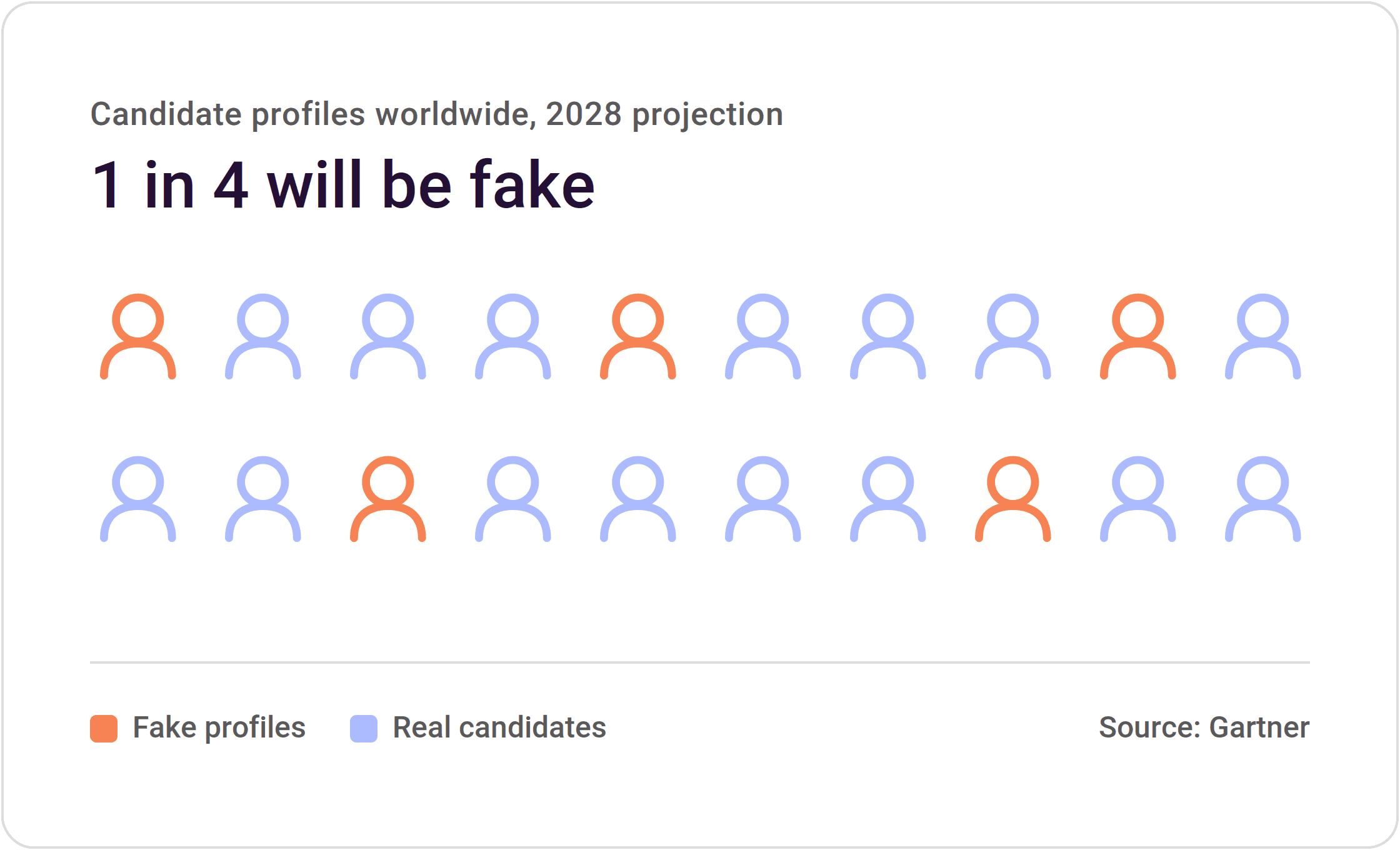
Layoffs put experienced people back in the job market. The market is full of talented people. Finding the ones who are genuinely engaged and genuinely qualified has gotten harder because they're standing in a crowd of automated applicants who in some cases don't exist. Gartner projects that by 2028, one in four candidate profiles worldwide will be fake.
Someone chasing a job, especially their dream job, should use every tool available, and Claude, ChatGPT, and Gemini are now part of how people apply. Businesses run on the same technology.
None of this means applicants are doing something wrong. Someone chasing a job, especially their dream job, should use every tool available, and Claude, ChatGPT, and Gemini are now part of how people apply. Businesses run on the same technology. The hard part is that both sides now have the same instruments, and the result is a market where the basic facts of an application are tough to trust. Getting both sides back to a ground level of truth is the real challenge.
What sourcing looks like now
In 2026 recruiters do not need to get lost constructing perfect boolean strings or managing candidate spreadsheets. Mature software handles the parts of sourcing that were most expensive: scanning profiles across multiple networks, building pipeline, looking up contact information, and running outreach campaigns.
The best of it gives talent acquisition professionals room to step in where their judgment matters most, and keeps them focused on the real requirements of the roles they're filling.
Are interested replies a truer signal than applications?
After these interviews we're convinced that applications carry less weight than they did even a year ago. Our customers keep wrestling with the same question: does an application reflect that person's actual experience, and is that person even a person?

A reply to outreach is different. Someone who answers a specific message about a specific role has read it, weighed it against a job they already have, and decided it's worth a conversation. They may use an LLM to help draft the response, but no one automates genuine interest in leaving their current position.
The teams we found thriving take a balanced approach. There are ways to handle the influx of AI-driven applications, and we focus on that too. Inbound recruiting still has a place. So does outbound, perhaps now more than ever.